120’ Dinner Cruise boat
New York to Cleveland
Vessel and Crew Snapshot
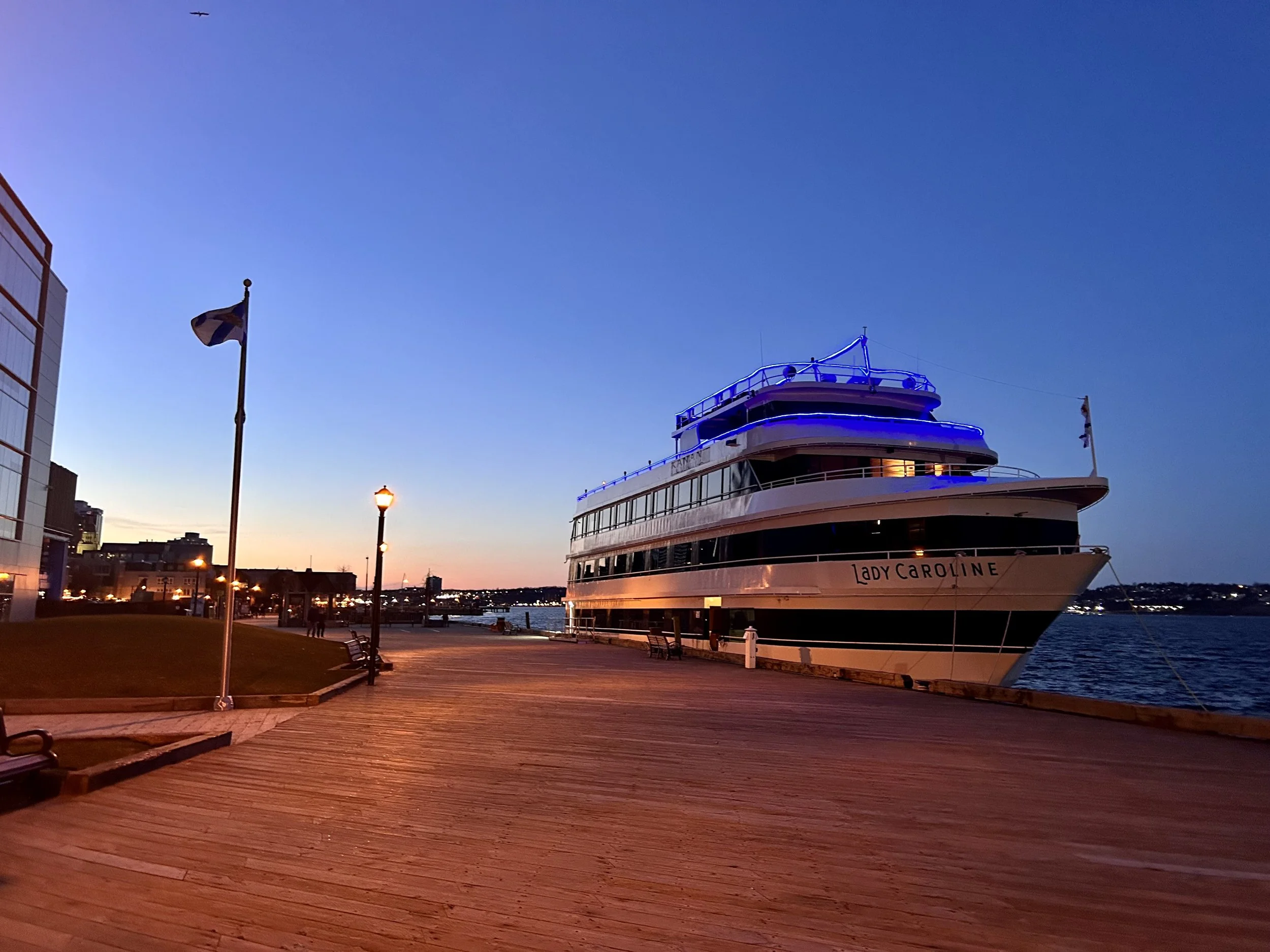
Vessel: Lady Caroline — 120′ dinner cruise vessel (high windage, commercial systems, limited maneuvering margin compared to smaller yachts).
Operating profile underway: steady 8 knots cruise. Long-distance delivery mindset: preserve machinery, reduce fatigue, keep the schedule realistic.
Crew onboard (8 total):
3 captains (rotating command / watchstanding)
3 deckhands (line handling, watches, lookout, maintenance support)
1 engineer (machinery, troubleshooting, preventive work)
1 cook (meals, galley logistics—critical for morale and stamina on 24-hour ops)
We ran this as a commercial delivery: formal watch schedule, written task lists, conservative decision-making in traffic and weather.
Phase 1 — Taking Delivery in New York City and Repositioning to New Bedford (Late October)
Delivery acceptance and immediate priorities (NYC)
We took delivery in New York City and treated the first day as a controlled handoff:
Verified propulsion response (ahead/astern, steering, temps/pressures).
Confirmed nav electronics were functional enough for offshore routing.
Checked bilge status, alarms, and pumps. On a boat this size, small leaks scale into real problems if ignored.
Established onboard procedures quickly: log intervals, radio protocol, and who owns what during watches.
I will be candid here: initial delivery days are rarely “fully known.” You’re taking someone else’s maintenance history and trying to build confidence while already in motion. We kept it conservative.
NYC to New Bedford — 2 days, running overnight
This was a two-day transit with overnight running. The key operational constraint was not speed—it was endurance and systems monitoring. At 8 knots, you are committing to long exposure: weather, traffic, machinery hours, and human fatigue.
Watchstanding: We operated overnight with rotating watches. The practical objective was simple:
Someone alert on the helm,
Someone dedicated to lookout / radar / AIS tracking,
And a habit of logging and physically checking spaces.
Arrival New Bedford and winterization
We arrived in New Bedford, Massachusetts later in October. The boat was secured and then winterized. With a capacity of over 300 guests the number of heads and water fixtures was impressive. We needed lots of anti-freeze!
Winterization focus was basic but time-consuming:
Protecting domestic water systems and any exposed plumbing.
Verifying heat / freeze protection where installed.
Shutting down and stabilizing machinery spaces for months of sitting.
Securing the vessel for weather, including lines, chafe gear, and checking dock exposure.
Outcome: vessel secured and stable for winter layup.
Phase 2 — Spring Return, Recommissioning, and North Atlantic Prep (April)
One week onboard: rebuild, recommission, verify
We returned in April and spent one week getting the boat ready for the long delivery. “Rebuilding systems” is not a slogan—on a large passenger boat that’s been sitting, it becomes a daily grind of small failures:
Pumps that won’t prime,
Sensors that read wrong,
Corrosion on terminals,
Valves that were “fine last season” but aren’t fine now.
The engineer drove a lot of this work, but it was all-hands by necessity. We treated every day like a punch list:
Start systems, run them under load, watch for secondary failures.
Verify critical spares onboard.
Confirm steering and propulsion response repeatedly.
Outfitting for the North Atlantic and Gulf of St. Lawrence
We also had to outfit the boat with safety gear appropriate for the North Atlantic and Gulf of St. Lawrence. That generally means moving beyond “harbor cruise” assumptions:
Additional survival and immersion considerations,
Communications and signaling redundancy,
And making sure the crew can respond to a worst-case event in cold water.
Safety gear included: Life Rafts, anchoring gear for deep water, additional fire extinguishers, updated AIS and radar system, immersion suits for each crew member. Plus safety training for everyone onboard.
Phase 3 — New Bedford to Nova Scotia: Cape Cod Canal, Gulf of Maine, and Yarmouth in Fog
Departure and watch schedule (24-hour operations)
We departed and transited the Cape Cod Canal, then pushed into the Gulf of Maine. We ran a 24-hour watch schedule. With three captains onboard, we could keep command decisions sharp while still giving people real sleep—if we protected the schedule.
In practice, maintaining a watch schedule requires discipline:
Meals at predictable times.
No “hanging out” after your watch.
Clear handoffs (course, contacts, weather trend, any machinery notes).
Right whales: speed and lookout discipline
In the Gulf of Maine we maintained heightened awareness for North Atlantic right whales. The practical impact is:
More time spent on lookout.
More conservative speeds in areas of concern.
A constant bias toward avoiding close approaches.
The frustration here is not dramatic—it’s procedural. You can’t relax the watch even when it’s late and visibility is imperfect, because the consequences of a mistake are severe.
Rounding to Yarmouth: thick fog and a constrained arrival
We continued to the tip of Nova Scotia and entered Yarmouth in thick fog. On a 120’ vessel, fog compresses your margin:
You make decisions earlier.
You slow earlier.
You confirm position more often.
And you accept that the last mile into port is sometimes the highest workload of the day.
Another challenge was the lobster fishermen out during this season. With pots scattered everywhere in thick fog, our speed was reduced, a lookout was placed low and forward. We used the ships horn one prolonged blast every two minutes. To hide the best fishing spots, most lobster fishermen operate without AIS. In the fog we could hear the lobster boats driving around near us, working, pulling traps, but we never saw them.
Outcome: safe arrival, but it was a workload-heavy approach.
Weather hold: 5 additional days in Yarmouth
Weather then held us in Yarmouth for five days. This was not wasted time, but it was constrained time. The observable issues:
Forecasts shifting just enough to keep you from committing offshore.
The crew’s routine becoming “maintenance + waiting,” which can create complacency if you let it.
Logistics: provisioning, keeping systems stable, and preventing small dockside issues from becoming major.
We used the delay for checks, maintenance, and rest. The main decision was simply not to force a marginal window. We took many trips to the local RONA hardware store to rebuild the fresh water system.
Phase 4 — Halifax Stop: Fuel and Waste Logistics
When weather broke, we ran to Halifax and stayed two days.
Reasons were practical:
Pump-out (holding tank management becomes an operational limiter on long transits).
Refueling via fuel truck.
Fuel-by-truck is rarely elegant. It is scheduling, hoses, paperwork, and making sure you don’t contaminate tanks or create a spill event. It takes the time it takes, and you plan the day around it.
Phase 5 — Nova Scotia to Quebec: Canso Canal, Tricky Navigation, and a Rest Stop at Rivière-au-Renard
Canso Canal transit and navigation complexity
From Halifax, we headed toward Quebec City via the Canso Canal. This area is not “hard” in a dramatic way—it’s hard in a professional way:
Route constraints,
Local traffic,
Changing conditions,
And limited room for improvisation on a large vessel.
We treated navigation there as a deliberate exercise: slower, more confirmations, more communication.
Stop at Rivière-au-Renard
We stopped at Rivière-au-Renard to re-provision and rest. That stop served two purposes:
Reset the crew after long watchstanding.
Reduce the temptation to push into the Gulf of St. Lawrence tired.
On deliveries like this, the biggest preventable risk is fatigue. You don’t feel it while you’re busy; you feel it when you make a sloppy decision.
Phase 6 — Gulf of St. Lawrence to Quebec City: Channel Discipline and Managing Local Fishing Activity
Learning curve: don’t hug the shore
As we moved up toward the Gulf of St. Lawrence and Quebec City, we learned quickly not to “save miles” by hugging shore. The issue was not geography—it was people:
French-Canadian fishermen working areas that make close-shore routing more complicated than it appears on a chart.
Gear and traffic patterns that reward staying in the channel, even if it’s longer.
We adapted: stay in the channel and accept the extra distance. The schedule impact was real, but the operational benefit was larger.
Voluntary enrollment: Seaway Traffic Management (STM)
We voluntarily entered the Seaway Traffic Management system, which required routine VHF check-ins. The tradeoff was worth it:
Added radio workload,
But better shared awareness—dispatchers knew where we were and could advise on hazards and ship movements.
I treated STM as a second set of eyes, not a substitute for our watch. It reduced uncertainty, especially in constrained waters.
Quebec City: overnight + paperwork
We arrived Quebec City, spent the night, and worked with Transport Canada on paperwork and clearances. This is where schedule optimism dies:
The boat does not care what your ETA is.
Paperwork does not care what your ETA is.
You do the steps, you wait your turn, and you keep the crew productive but not burnt out.
Phase 7 — Montreal and the Seaway: Inspection, Locks, and Clearing Back Into the U.S.
Montreal: inspection and onward transit
The next day we departed for Montreal and completed a Seaway inspection. After passing inspection, we continued into the St. Lawrence Seaway for our upbound transit.
Lock work on a 120’ vessel is repetitive, physical, and unforgiving:
Lines must be ready early.
Deck crew must be briefed the same way every time.
Fenders must be managed constantly.
You avoid improvisation unless you have no choice.
There are seven locks between Montreal and Lake Ontario:
Canadian Locks: 5 (St. Lambert, Cote St. Catherine, Upper Beauharnois, Lower Beauharnois, Iroquois)
U.S. Locks: 2 (Snell, Eisenhower)
Each lock is a little different and going between the US and Canada – while thankfully it did not require checking/clearing customs – did require moving between two different systems and ways of operating.
Stop: Clayton, NY (fuel and U.S. check-in)
We stopped in Clayton, New York for fuel and to check into the U.S. This stop functioned as:
Compliance,
Operational reset,
And a chance to verify the boat’s condition after multiple locks and long hours.
I also procured good coffee from the local bakery and a decorative nautical-themed pillow for my mom.
Phase 8 — Lake Ontario and the Welland Canal: Staging, Early Transit Window, and Fatigue Management
Staging at St. Catharines (Welland Lock #1)
We ran to Lake Ontario and staged overnight in front of Welland Canal Lock #1 in St. Catharines. The reason was practical: be positioned to start early and run the canal efficiently.
Unbound transit through the Welland Canal
We started through the Welland in the morning. Because we were a large vessel and moved before the recreational season ramped up, we could run the canal with fewer conflicts than later-season traffic.
Even with lighter traffic, the workload is high. There are 8 locks in the Welland Canal System, rising equal height of Niagara Falls. Tasks onboard included:
Crew on lines repeatedly,
Strict adherence to instructions,
No room for distraction,
And constant attention to wind effects on a high-sided vessel.
Post-Welland stop: exhaustion dictates
After clearing the Welland, we spent the night. Everyone was exhausted. This was not optional. Past a certain fatigue point, “pushing one more leg” is where mistakes happen.
Phase 9 — Lake Erie to Cleveland: Night Arrival, Tug Escort, and Final Docking
Transit to Cleveland (Lake Erie crossing)
We continued toward Cleveland the next morning. Do not discount the chart areas that warn of “Unmarked Well Heads” this is legitimate, there are fields of unmarked well heads on the Canadian side of Lake Erie. It’s best to cross into US waters to transit the lake. The crossing took 1.5 days, entering at night. A night arrival after long transits is where experience matters:
People are tired,
Visibility is limited,
And local traffic can surprise you.
Towboat escort into dock
We were fortunate to have a friend who runs a towboat in Cleveland and he came out to escort us to the dock. That escort reduced risk materially:
Better local knowledge,
Better control if conditions tightened,
And an extra professional set of eyes in a confined approach.
We docked at a temporary location to prep for the christening.
Phase 10 — Commissioning for Service: Two Days of Turnaround and the Move to Jacobs Pavilion
Two-day prep surge
For two days, the boat shifted from “delivery mode” to “event mode.” The difference is immediate:
Decorators, caterers, cooks, hostesses—large numbers of people onboard.
Supplies moving constantly.
Systems being used heavily (power, HVAC, water, galley loads).
Cleaning, staging, and last-minute fixes.
Window washing the exterior – I put on the harness and went out.
The operational challenge is crowd control and safety:
Keeping walkways clear.
Managing shore power and load, using generators when necessary.
Maintaining basic vessel security while vendors come and go.
Final move: Cuyahoga River to Jacobs Pavilion
After prep, we left the dock and ran up the Cuyahoga River to the Lady Caroline’s new home at Jacobs Pavilion. Media was present during the entrance with much fanfare.
This final leg was short but not low-stakes:
Tight quarters,
Spectators,
Cameras,
And no tolerance for a docking mistake after a long delivery.
We brought her in, secured, and transitioned the vessel to her operational home port. The day was wonderful, a brief christening ceremony followed by an open showing of the vessel. The champagne flowed and
What Worked, What Didn’t, and What I’d Change
What worked
Three-captain rotation made true 24-hour operations possible without burning out command judgment.
Weather discipline in Yarmouth: five-day delay was inconvenient but aligned with safe offshore decision-making.
Voluntary STM enrollment reduced uncertainty and improved situational awareness.
Stopping when exhausted (post-Welland) prevented avoidable mistakes.
Friction points (observed, not dramatized)
Delays compound on a big delivery: weather holds + paperwork + fuel logistics + inspections. Each one is manageable; together they erode schedule flexibility.
Tight-navigation areas (Canso / Seaway / canals) shift workload from “driving” to “managing people and procedures.” You need the crew briefed and repetitive.
My own mistakes / uncertainty
We underestimated how quickly the administrative and compliance steps would dictate the tempo (Transport Canada, Seaway inspection, U.S. check-in). It’s obvious in retrospect, but in planning it’s easy to forecast nautical miles and forget the time that gets taken away by bureaucracy.
Grounded Takeaway / Next Step
A long repositioning on a 120′ passenger vessel is less about seamanship moments and more about process discipline: watch schedules that actually protect sleep, conservative routing in local traffic and fishing zones, and accepting that logistics and clearances set the real timeline.
Next step after arrival and christening prep is straightforward: convert the delivery logs into an operational baseline—engine hours, fuel usage records, deferred maintenance list, and a prioritized systems plan—so the local Cleveland operating team inherits a boat with a clear, documented starting point rather than a pile of verbal handoffs.